Welcome to Wildlife Wednesday! At this time of year, many people take to the great outdoors to camp, hike, picnic, and enjoy the natural world, thereby communing with nature. But, as you’re out there hiking through the woods and fields, be aware that something is waiting for you. Something that is on a quest for blood. Something as frightening as Dracula and Arachnophobia combined! It’s so scary, it might even give you a nervous tick!
Today, we’ll talk about ticks in general, their life cycle, and a few of the diseases they can transmit to humans.
Ticks are tiny invertebrates in the taxonomic class Arachnida, meaning they have 8 legs, no antennae, and only two body segments. They’re close relatives of spiders, scorpions, and mites. There are over 850 species of ticks in the world, but only about 90 species are found in the US. There are 48 species established right here in California!
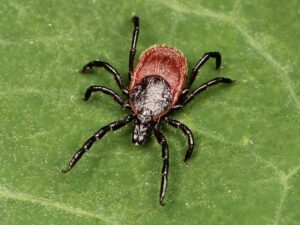
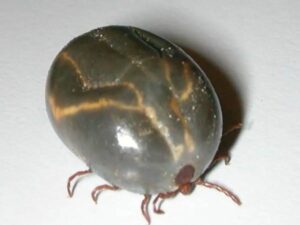
Of course, ticks are best known for being real-life, mini vampires. Ticks suck! They want to suck blood! Not necessarily YOUR blood, but the blood of any number of hosts. Ticks can feed on a variety of mammals, birds, reptiles, and amphibians. Here in California, the Western Black-legged Tick has been recorded feeding on 108 species of lizards, birds, and mammals, and it attaches to humans more frequently than any other tick species in the state!
Ticks can’t jump or fly to land on their host. Instead, they crawl up low brush or grass, clasp on with their hind legs, then reach out with their front legs and wait to grab onto a passing animal or human. This process is called “questing.” Sometimes, like little daredevils, they even drop from their perch and free-fall onto a passing host!
Ticks find their host by detecting an animal’s breath, odor, heat, moisture, or vibrations through specialized organs on their front legs. That’s why a questing tick typically has its front legs stretched out in front of its body. Research has found that some species can even recognize a moving shadow as a sign of an approaching host! Some ticks will attach to their host quickly, while others will wander, searching for areas such as the ear or other locations where the skin is thinner and blood vessels are closer to the surface. Cottontails, jackrabbits, and deer are often seen with multiple ticks embedded on their big ears!
When the tick finds a feeding spot, it grasps the skin, piercing the surface, and then inserts its feeding tube, which is barbed to help keep the tick firmly anchored while it’s dining. As the tick feeds, it releases small amounts of saliva with anesthetic properties so the host animal or person can’t feel that the tick has attached itself. Diabolical!
Since the tick releases saliva into the host animal’s blood, if the tick is carrying a pathogen, such as a bacterium or a virus, that organism may be transferred into the host animal’s body. Just the fact that ticks suck blood is enough to gross out most people. However, mention the myriad diseases that can be transmitted from ticks to humans, and most people get ticked off!
Some of these tick-borne diseases that occur here in California include Lyme disease, Tick-borne relapsing fever, Anaplasmosis, Pacific Coast tick fever, Rocky Mountain spotted fever, Babesiosis, and Colorado tick fever. According to the California Department of Public Health, of those 7 diseases, Lyme disease is the only one with more than 10 confirmed cases per year in the state. The rest are all scarce.

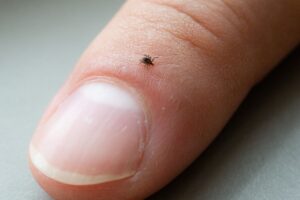
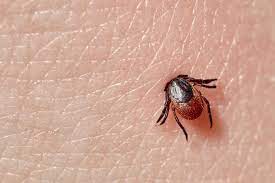
Lyme disease is caused by a corkscrew-shaped bacterium called Borrelia burgdorferi, and, here in California, it’s only transmitted to people by the Western Black-legged Tick. In most cases, a tick must be attached for 36 to 48 hours or more before the Lyme disease bacterium can be transmitted. In 2023, 123 cases of Lyme disease were reported in California. However, that might sound like a lot, compared to New York, which had 21,466 cases recorded! Lyme disease is MUCH more common in the eastern part of the United States!
Lyme disease can produce a wide range of symptoms, depending on the stage of infection. Symptoms can include fever, rash, facial paralysis, and arthritis. Over time, it can become quite debilitating for some people. The best sign to look for, which occurs in 70-80% of infected people, is a circular rash 12 inches or more in diameter. This rash sometimes has a target or bull’s-eye appearance, with the center red spot corresponding to where the tick was embedded. Symptoms can vary greatly, so don’t just let your doctor make a “rash” diagnosis. Early-stage Lyme disease is typically treated with a course of antibiotics lasting 10 to 14 days and usually results in a complete recovery.
Fortunately for us here in California, we have a superhero in our midst who helps guard us against Lyme disease! One of the most common reptiles in the state, the Western Fence Lizard, also known as the Blue-bellied Lizard, has a unique protein in its blood that kills the bacteria that cause Lyme disease. This is significant because the juvenile stages of the Western Black-legged Tick often feed on lizards. If the ticks are previously infected, then eating the lizard’s blood will kill the Lyme disease bacteria, and they won’t be able to pass it on to their next host. In other words, our local lizards appear to be cleansing infected juvenile ticks and protecting all of us! This is the reason why there’s a relatively low Lyme disease infection rate here in California!
If you step outside to gaze at the moon tonight, watch out for luna-ticks! Don’t let them get under your skin!